
Explore Nepal’s Himalayas through high mountain passes, remote valleys, and living mountain cultures.
The Great Himalaya Trail (GHT) is a network of trekking routes spanning Nepal’s Himalayan regions, connecting Kanchenjunga in the east with Humla in the west. The Nepal High Route covers approximately 1,700 kilometres, although the actual distance varies with the route and access points chosen.
You can experience the GHT as a demanding expedition across Nepal or explore it through shorter regional journeys. Along the way, landscapes shift from forested hills and cultivated valleys to alpine pastures, glacial terrain, and dry trans-Himalayan plateaus.
For travelers considering a Great Himalaya Trail trek in Nepal, the most important decision is choosing a section that matches your experience, available time, and preferred level of support.
|
Feature |
What to expect |
|---|---|
|
Location |
Nepal Himalaya, from the eastern mountains to the far west |
|
Route options |
High Route, lower cultural routes, and combinations |
|
Distance |
Approximately 1,700 km for the Nepal High Route; varies by itinerary |
|
Duration |
Several months for a full traverse; shorter sections can be planned separately |
|
Difficulty |
Varies from demanding trekking to technical alpine travel |
|
Accommodation |
Teahouses, local lodges, and camping, depending on the section |
|
Best time |
Depends on the region, altitude, and passes included |
|
Planning priorities |
Acclimatization, permits, experienced support, resupply, and weather flexibility |
The GHT is a flexible network rather than one uniform trail. Confirm the exact route, overnight stops, technical requirements, and access arrangements before booking.
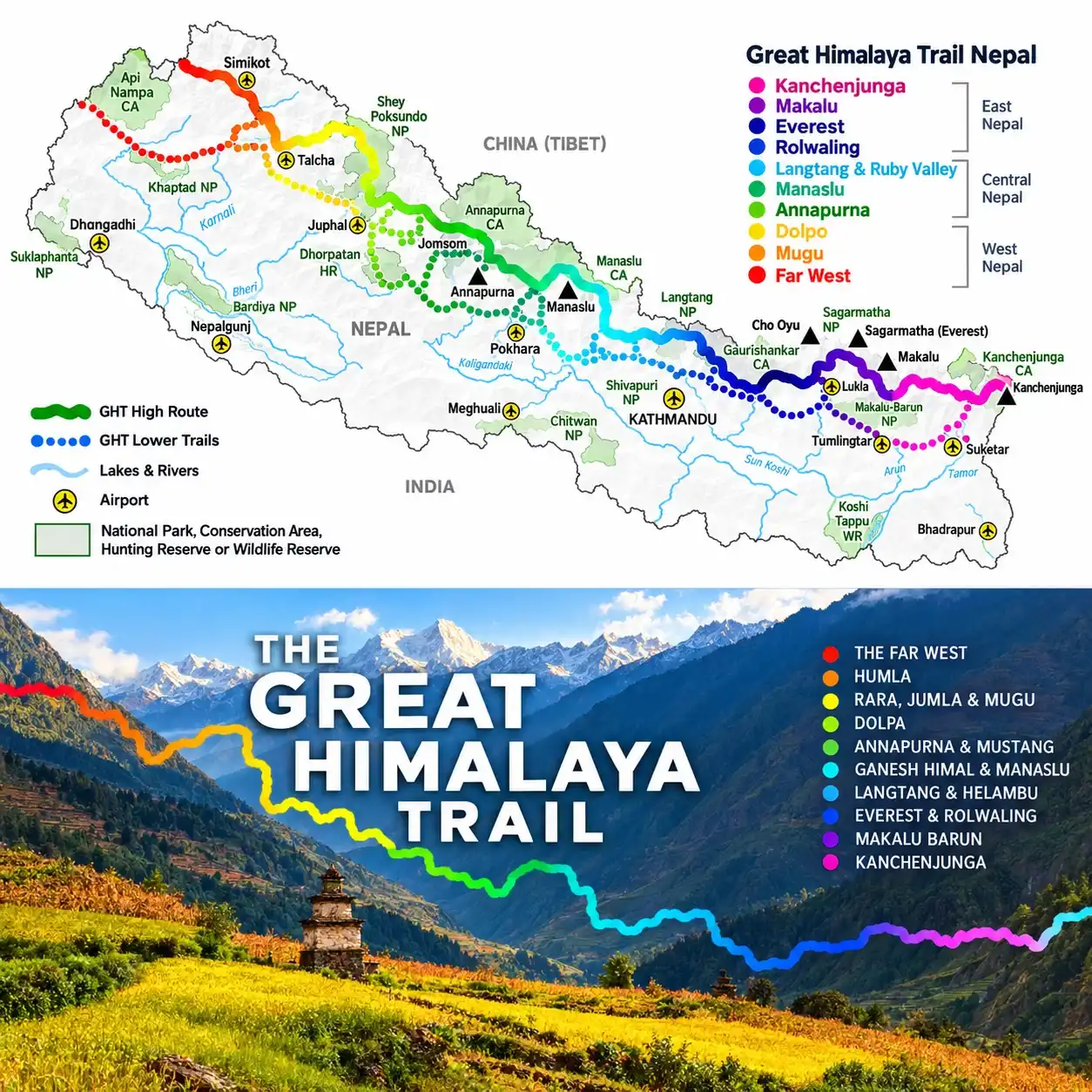
The GHT offers the opportunity to explore the variety of Nepal’s mountain landscapes and communities within one broader journey.
Depending on your itinerary, you may:
Its appeal lies in this flexibility: a carefully chosen regional trek can be as rewarding as a longer traverse.
GHT High Route: Alpine Landscapes and Expedition Challenges
The High Route follows demanding mountain terrain, with repeated high passes and remote stretches between settlements. Certain connections involve technical glacier crossings and require mountaineering equipment, relevant experience, and specialist guidance.
Crossings such as Sherpani Col, West Col, Amphu Labsta, Tashi Labsta, and Tilman’s Pass need particular attention during route planning. They should not be presented as ordinary trekking passes.
This option is best considered by experienced mountain travelers who are comfortable with sustained physical effort, basic facilities, and changes to the itinerary.
Lower cultural routes place greater emphasis on inhabited valleys, forests, terraced hillsides, and local walking trails.
These journeys can offer more opportunities to spend time in villages and learn about everyday mountain life. However, “low route” does not automatically mean easy: long walking days, steep climbs, and basic accommodation may still be involved.
Route alignments also change as roads and local infrastructure develop, so itineraries should be checked against current conditions.
The following are regional planning options rather than fixed stages. Connecting routes, access points, and side trips determine the final itinerary.
Eastern Nepal offers remote valleys, high mountain scenery, and journeys around Kanchenjunga and Makalu. This region suits travelers seeking a substantial wilderness experience with carefully organized logistics.
The Everest region combines established trekking infrastructure with opportunities for more demanding journeys toward Rolwaling. Technical connections require a different level of preparation from a standard
These regions offer opportunities to combine mountain landscapes with village visits and quieter connecting trails. Choose a regional trek or investigate a longer traverse according to your experience.
Explore the contrast between the greener valleys around Annapurna and the dry landscapes of Mustang. Upper Mustang is a distinct itinerary choice; it should not be assumed to be included in every GHT journey.
Western Nepal appeals to travelers interested in remote trekking, high plateaus, monasteries, and journeys around destinations such as Phoksundo Lake and Rara Lake. Their inclusion depends on the selected route.
Humla offers access to Nepal’s far western mountain landscapes. Simikot is an important planning point, while some traverses continue toward Hilsa.
Choose your section by its actual itinerary rather than its name alone. Ask which passes, villages, lakes, and access points are included.
The best time depends on the section you choose.
Spring and autumn are common starting points for planning many regional treks. However, high passes can remain affected by snow, and conditions vary considerably between eastern, central, and western Nepal.
Parts of Mustang and Dolpo lie in the Himalayan rain shadow and may offer summer trekking possibilities. Access journeys and connecting trails can still be disrupted by monsoon weather.
A full traverse requires a separate seasonal strategy because it lasts several months and crosses different climatic zones. Choose departure dates around the most demanding crossings, with contingency time for delays.
A GHT journey can introduce you to Nepal’s diverse mountain communities, languages, livelihoods, and religious traditions.
Depending on the region, experiences may include visiting Buddhist monasteries, observing agricultural life, staying in locally operated lodges, and learning about the historical connections between Himalayan valleys.
Travel respectfully: ask before photographing people, follow local guidance at religious sites, and choose services that bring income to the communities you visit.
Accommodation varies substantially along the GHT.
Established trekking areas offer teahouses and lodges, while remote connections may require tents, a cooking team, and food carried between resupply points. Facilities, meal choices, charging, and communication access differ between locations.
Before booking, request an itinerary that clearly identifies lodge nights, camping sections, meal arrangements, and resupply plans.
The difficulty of a Great Himalaya Trail trek depends on altitude, terrain, remoteness, duration, and technical crossings.
A full High Route traverse requires more preparation than a conventional regional trek. Shorter sections also need careful assessment rather than being treated as automatically suitable for beginners.
Discuss the following before choosing your route:
Permit requirements depend on the areas crossed. Your itinerary may require restricted-area trekking permits alongside relevant protected-area entry permissions. Confirm the current requirements for the complete route before departure.
There is no single standard GHT price. Costs depend on trip length, group size, transport, permits, camping support, technical staff, and resupply arrangements.
Request an itemized quotation that explains what is included, what costs extra, and how itinerary changes are handled.
Yes. You do not need to cross Nepal to experience the Great Himalaya Trail.
Regional options to discuss include:
Some popular treks explore areas connected with the wider GHT network without completing a continuous GHT section. Check the route description if completing a particular section is your goal.
What is the Great Himalaya Trail?
The Great Himalaya Trail is a network of routes connecting Himalayan trekking regions. In Nepal, it offers options ranging from individual regional journeys to a long-distance traverse across the country.
How long is the Great Himalaya Trail in Nepal?
The Nepal High Route is approximately 1,700 kilometres. Your actual distance depends on route variations, side trips, and starting and finishing points.
How long does a full GHT trek take?
A full traverse takes several months. The final duration depends on the chosen route, acclimatization, rest days, technical sections, and weather delays.
Is the Great Himalaya Trail suitable for beginners?
A full High Route traverse is unsuitable as a first trekking experience. Beginners should discuss a more accessible regional itinerary based on their fitness, experience, and comfort with basic facilities.
Does every GHT trek require climbing skills?
No. Technical requirements depend on the route. Certain alpine connections require mountaineering skills and equipment, while alternative itineraries can avoid those crossings.
Can the GHT be completed over several trips?
Yes. You can explore different regions over separate visits, choosing suitable dates and difficulty levels for each section.
Plan Your Great Himalaya Trail Journey with Ghumnajaau
Start with the region and experience that interest you most—high mountain passes, village life, remote camping, or a combination.
Share your available dates, trekking experience, group size, and preferred level of comfort with Ghumnajaau to discuss a suitable itinerary.
We create unforgettable trips, customized for your group.